
Did it ever have a plan?
Accra couldn’t stay by plan, for a lot of people, they create their own plan because the culture doesn’t agree. Systems are decorative. The people are performative – appearing to make the rules, bend the rules, and then blame the government, or hey! their next door neighbour. It is survival; sometimes sharp, often deceptive, and occasionally malicious, depending on the room you find yourself in. Or did we simply rename improvisation and cunning as intelligence? We call it strategy. We praise it as brilliance. We reward the one who “figures it out.”
Accra is fluid. Not intentional, just… fluid. The kind that celebrates “go with the flow” without ever asking, flow to where? Planning, we say, is stiff. Too rigid. Too slow. Too naive. But is it? Or is it simply inconvenient for those who benefit from disorder? Because real planning demands accountability. It demands foresight. It demands that you answer for outcomes, not just outcomes that favor you. And that is where the problem begins. So we create loopholes.
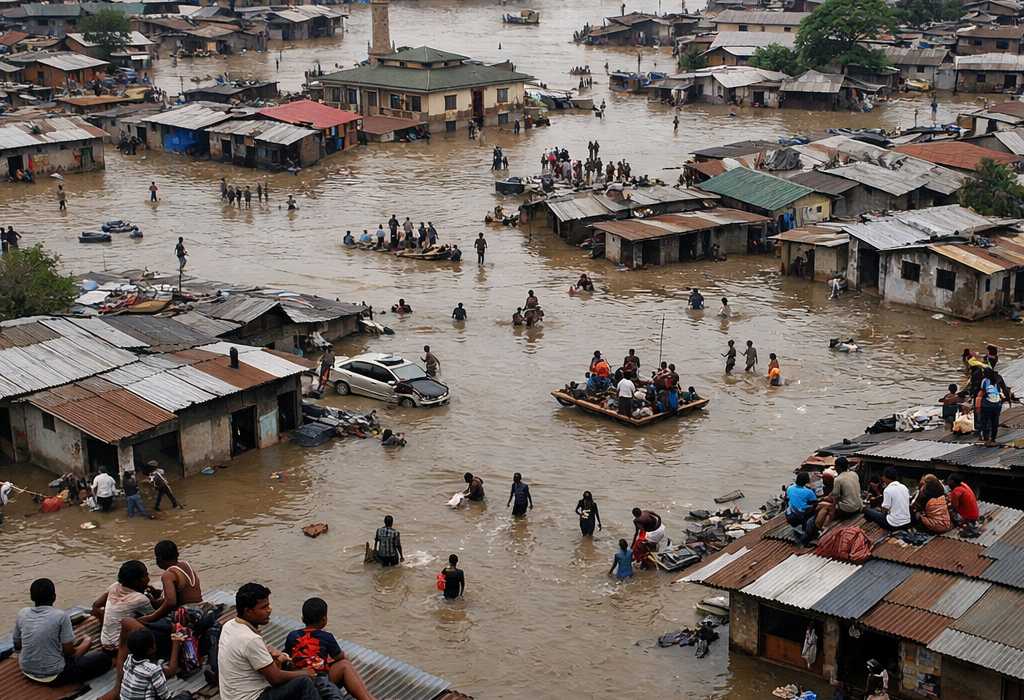
Yet again, Accra is fluid; the kind that geographically sits in a lagoon. Several lagoons, in fact: Korle, Chemu, Kpeshie, the Odaw – disrespected and ignored, as though our limited man-made innovations could withstand the powers of the god-living deities in those waters. We assumed Burj Al Arab was a joke – as if building on the sea, deliberately, is a fantasy, while we build against it, carelessly, and call that normal.
Accra is fluid; it’s the kind today’s well-positioned men widely enjoy. Because planning is stiff. It removes the flow of energy and flexibility. It creates a room, oh, several rooms, for the ones who need not account for their errors. Brown envelopes are not hard to come by for such bodies. Have you seen their bodyguards? When Pappy Kojo dropped “Awo’a” and let the line ring out – we run run things –he had them in mind.
But of course, a fluid city should understand its future; it looks like urbanization always takes the hit when the systems leading the cause aren’t thorough. City planning is but for a few established entities; the encroacher is allowed to fence the wall without consequence because “oh, where will they sleep, God bless your kind heart” – indeed, let’s be hospitable, let’s help the needy, but more importantly, let’s get a working system: clearly defined regulations, and enforcers who get the job done. So we don’t blame Aunty Akos and co… we blame Mahama and co. But Aunty Akos and co do not have history of the land. Her limited resources can only afford her a kiosk – what are her options? A working government that considers basic needs as the highest reason for anyone leaving their hometown for a small kiosk in a city that’s been wrongly advertised as better than the others outside of it – Accra.
So, the hustler will do what it takes: get the land or the kiosk, pay the cut, and get to feed. Accra couldn’t stay by plan, for a lot of people; their dreams are only closely exercised outside their doors; danger looks like an opportunity to try even harder. Because “it’s only rain,” “the delivery must be sent,” “my HR is brutal”– these are the kind of nuanced conversations we cannot simply discuss as bystanders who happen to have bandwidth to spare. It’s the trotro driver still on the road when the gutters overflow because the day’s transport fee hasn’t been made. It’s the trader who won’t leave the flooded stall because the goods in it are the only capital she has. A working condition that’s far removed from human consideration– a case of Ghana’s brutal employment culture, worn like it’s just weather.
A lot of well-meaning conversations, no clear path toward a nationwide responsibility or campaign. So we use the internet as our outlet. Are they even listening? The timing seems perfect, when the fault goes live, when the harm is already done.
For years, the Ghanaian citizen has complained about maintenance culture – innocently removing ourselves from accountable, responsible behaviour. And the government has the policies, until it is time to implement, to enforce action.
So let’s wait for another uprising; a June 3rd, a June 29th, to remember what needs should be prioritized. Eleven years apart, almost to the day: June 3, 2015, when the floodwaters met the fuel at Kwame Nkrumah Circle and the fire took what the flood hadn’t. June 29, 2026, this week, when the rains came again and the same drains failed the same way. The disaster doesn’t repeat because we forgot. It repeats because remembering was never followed by fixing.
Nonetheless, let’s embrace the many lenses, interrogate their cause, and refine them, such that we curb tomorrow’s deadly fate today. Stop littering, yes, but that was always the smallest ask, the one that costs nothing and changes little on its own. Stop pouring your grey water and your refuse straight into the gutter outside your gate, because that is where most of what floods a street actually begins. Ask who owns the plot before you build on it, before you rent it, before you call it opportunity because half of what drowns every June was wetland before it was “prime real estate.
While Accra couldn’t stay by plan in some cases, your Accra can stay by plan; with meticulous planning and continual learning, and an honesty about who is actually being asked to change. I invite you to take the first step. Not because it is the whole fix. Because it is the one piece of the plan that was always, only, yours to keep, and because someone, somewhere with more power than you, still owes the rest.
Brilliant! This is a powerful reminder that resilient cities are built not by simply reacting to disasters, but by pairing personal responsibility with consistent planning, accountable leadership and the courage to enforce the systems that protect everyone. Thank you for sharing this with us!
Thank you for confirming this truth… Hopefully, we can be the change in our own little corners.
Planning in itself cannot be said to be rigid. Planning must be sustainable and inclusive. Planning as a culture must be dynamic. Sustainable Development Goal (SDG) 11 summarises it all.
And you’re spot on!
This is an intelligent, balanced, and emotionally compelling critique of Ghana’s recurring flood disasters. Its central insight that recurring tragedy stems not from ignorance but from a failure to act is both persuasive and memorable. The piece successfully resists simplistic blame, instead arguing that while citizens have responsibilities, governments and institutions bear a greater duty to plan, enforce, and maintain the systems that protect lives.
With a clearer opening, smoother transitions, and slightly tighter phrasing, this would read like a publication ready opinion piece. As it stands, it is a strong and thought-provoking commentary that invites reflection rather than outrage—a quality that often makes writing more enduring and persuasive.
You write incredibly well Ama.
Accra is poorly designed and usually design is the best predictor of behavior, I truly wish our city would become the one we’d intentionally build
Intentional planning can take us there. Soon, we hope.
Accra never had a plan to stay by; each individual just have to play their part in this planning. Beautiful piece; I LOVE IT
Absolutely! brick by brick, we should find a good rhythm for Accra.